The Wreck Explorer · North Sea collection
HMT Garmo in 3D
A Grimsby steam trawler, built at Hull in 1900, hired by the Admiralty in November 1914 and lost to a mine off Scarborough on 20 December 1914. Six men died. This viewer brings together what is documented about her, what divers report of the wreck and what we have had to interpret, and labels each of them.
What this 3D scene shows
Documented Measured survey Genuine photograph Diver account Interpretation Artistic reconstruction Disputed
1914 · Afloat
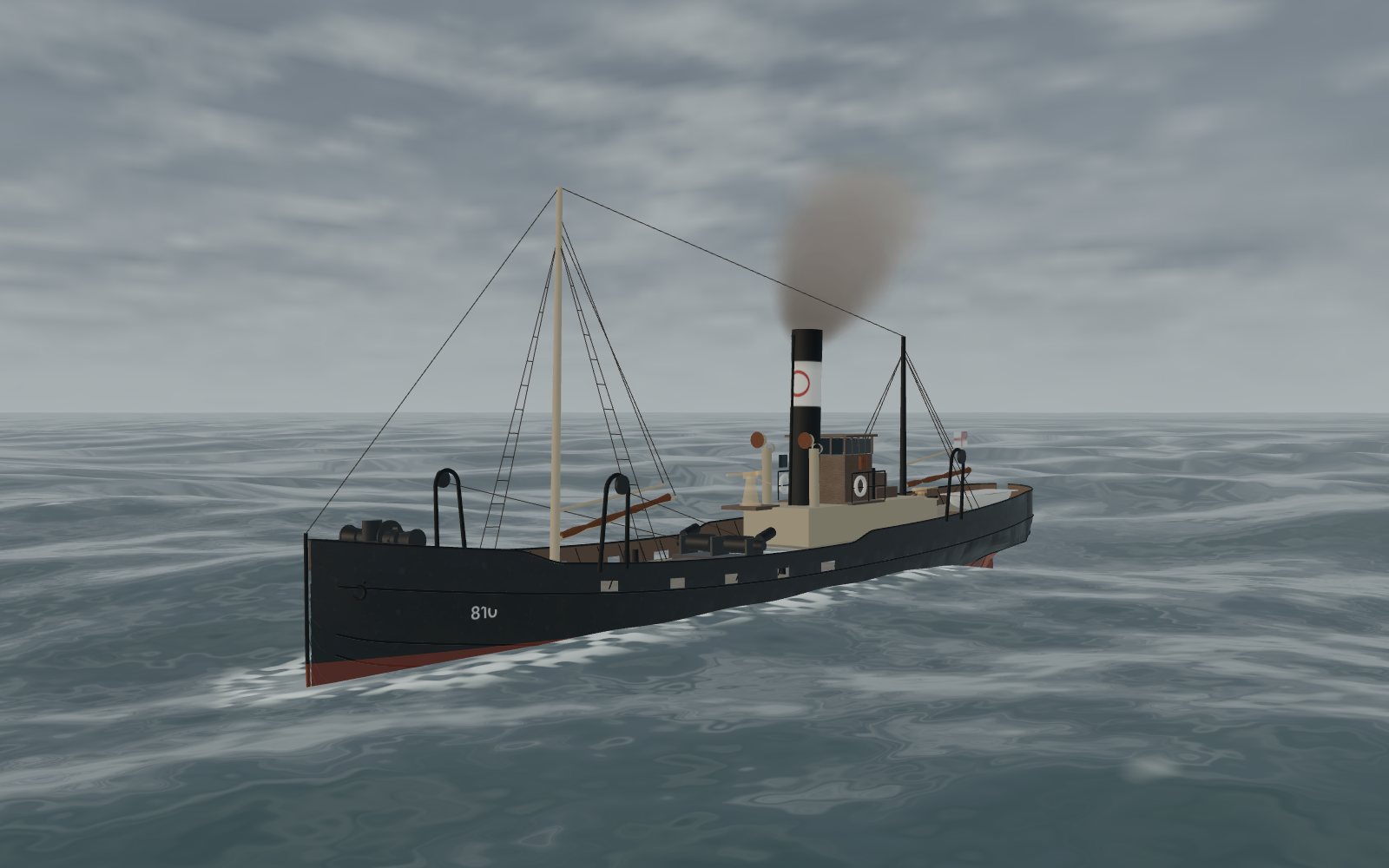
The intact trawler as she may have looked in December 1914: steel, single screw, ketch-rigged, with a raised forecastle and quarterdeck, one funnel, a wheelhouse abaft it and a single boat. Her dimensions, rig, machinery and fittings come from her registry entries and her 1900 Lloyd’s Register survey file; the arrangement of her deck follows photographs of her Earle’s-built sisters and period practice. No photograph or plan of Garmo herself has been found. Colours, markings, weather and sea state are reconstructions.
Plumb stem
Documented
A straight stem with no figurehead (“head: none” in the 1900 survey) and no bowsprit. The registered length of 34.20 m runs from the stem to the sternpost.
Windlass on the forecastle
Documented Position: interpretation
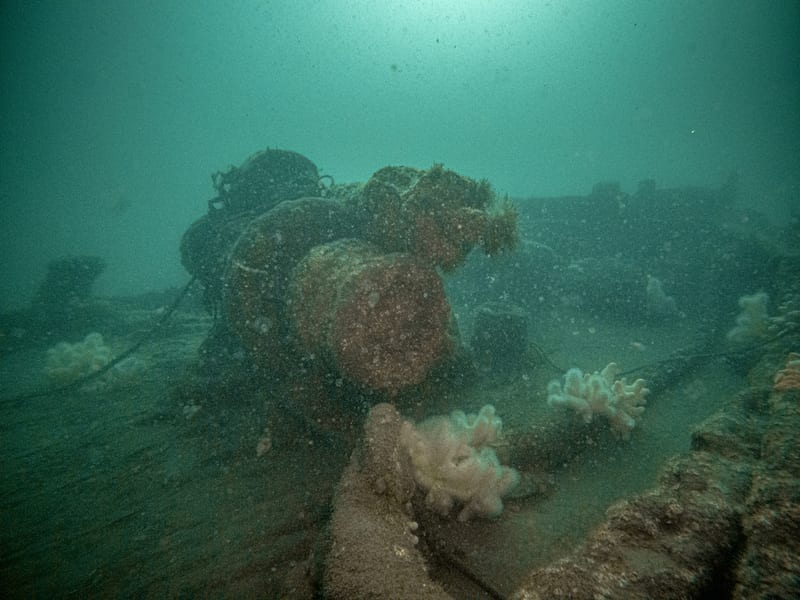
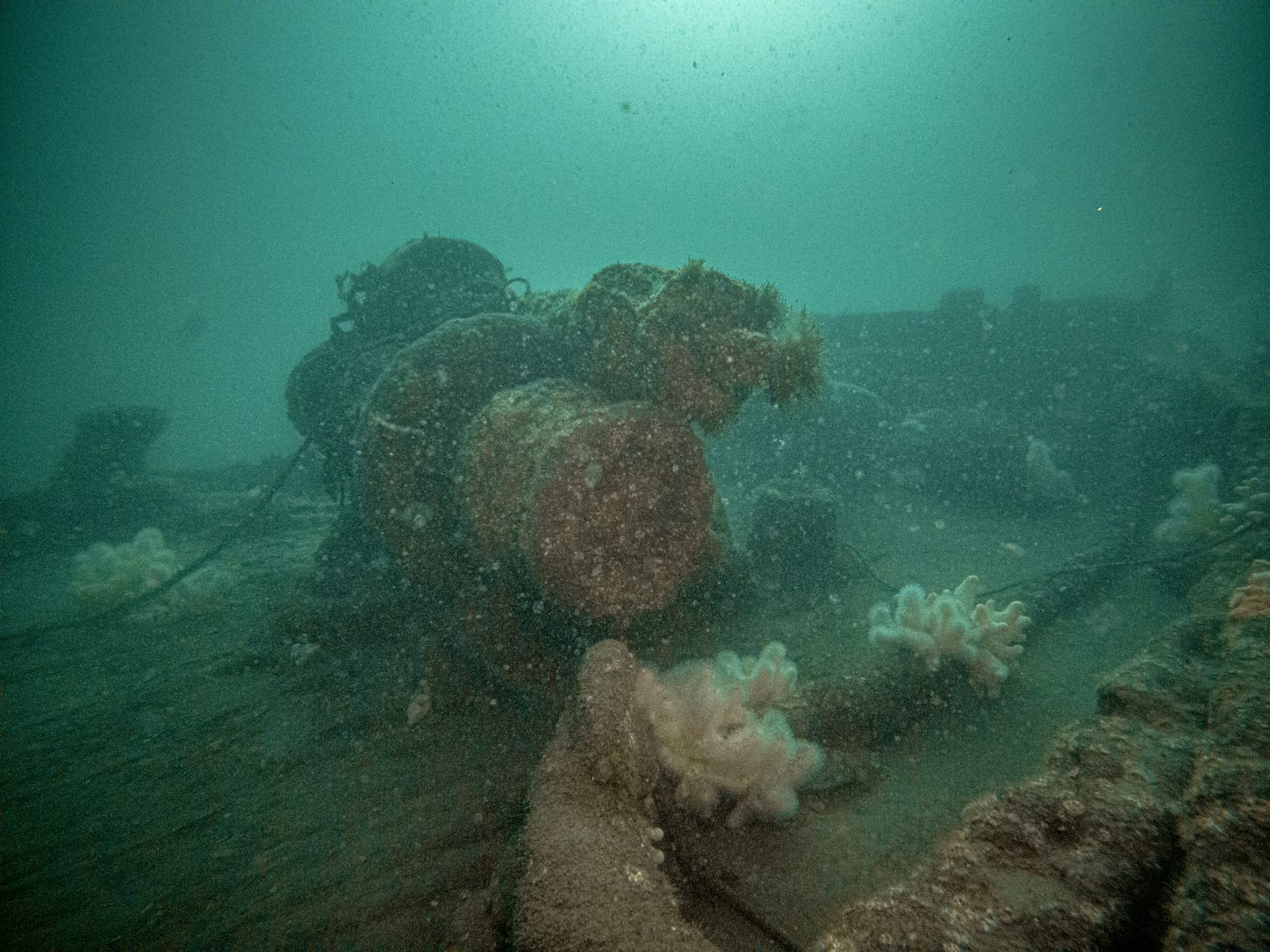
The survey records an iron patent windlass and no capstan, with three stocked anchors on 162 m of 1-inch chain. The same machine is very probably the “anchor winch” in Danny Myers’ photograph of the wreck.
Raised forecastle, 20 ft
Documented
Lloyd’s Register gives a forecastle of 20 ft (6.10 m) and a quarterdeck of 50 ft (15.24 m). The survey shows both are low raised decks, only 1 ft (0.30 m) above the main deck.
Ketch rig
Documented Heights: interpretation
Two masts: a pine pole foremast and a steel mizzen 32 ft 4 in long. The tanned sails were auxiliary to steam. Mast positions and the foremast’s height are inferred.
Gallows
Interpretation
Inverted-U frames that carried the trawl warps over the side. Their positions follow period practice; which side she worked from is not recorded, so both are drawn.
Fish hold
Hatch sizes documented Positions: interpretation
The survey lists the hatch sizes; where each sat on the fore deck is inferred.
Steam trawl winch
Interpretation
A double-barrelled steam winch stood across the deck forward of the casing, by period practice. No details of Garmo’s own winch survive.
Gun mount
Interpretation
Garmo is recorded only as “armed”; her sister Drake carried one 3-pounder. Both diver accounts place the fallen gun on the deck just in front of the boiler, starboard; if it fell close to its seat, that points to a mount forward of the funnel. Drawn as a ghost: the mount itself is not recorded.
Funnel
Single funnel documented Colours: reconstruction
Black, with a white band and a red “O” for the Ocean Steam Fishing Company, after a company livery illustration whose basis is unknown.
Wheelhouse abaft the funnel
Interpretation
Photographs of her sister Drake and fleet-mate Bravo show the Humber arrangement, with the bridge behind the funnel. The earlier model had it the wrong way round.
Steel mizzen mast
Documented
32 ft 4 in long, built of two steel plates, carrying a small steadying sail.
One boat
Documented Size: interpretation
The survey records one boat. Size and stowage are inferred.
Elliptical counter stern
Documented
The registry form says “elliptical”: an overhanging counter, not the pointed stern of the earlier model.
Propeller
Documented
Four blades, 8 ft 2 in (2.49 m) across, driven by a triple-expansion engine of 52 RHP. Hidden below the waterline here.
20 December 1914 · The loss
Mid-morning, at about 10:00 to 10:15, Garmo struck a mine in the field laid off Scarborough during the German raid of 16 December. The despatch in the London Gazette says she was floating “nearly vertical … with only the forecastle above water”, and that she “turned completely over and sank”. Other accounts say she sank quickly by the stern. The drifter Principal rescued survivors. Five men died that day; Skipper Thaddeus Gilbert died of his wounds the next. The view keeps its distance and shows no explosion. How she came to rest upright on the seabed is not recorded, so it is not animated.
Today · The wreck
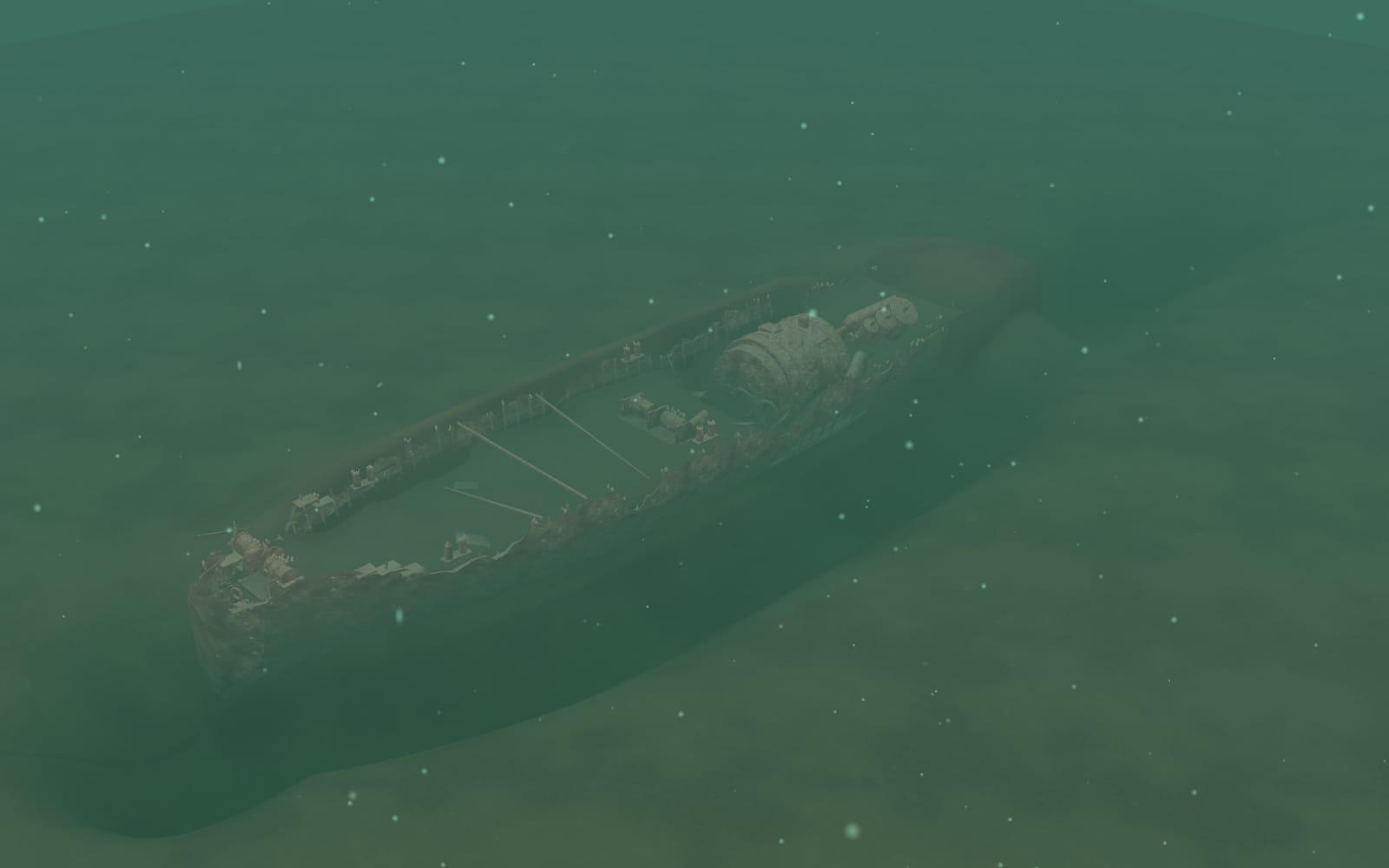
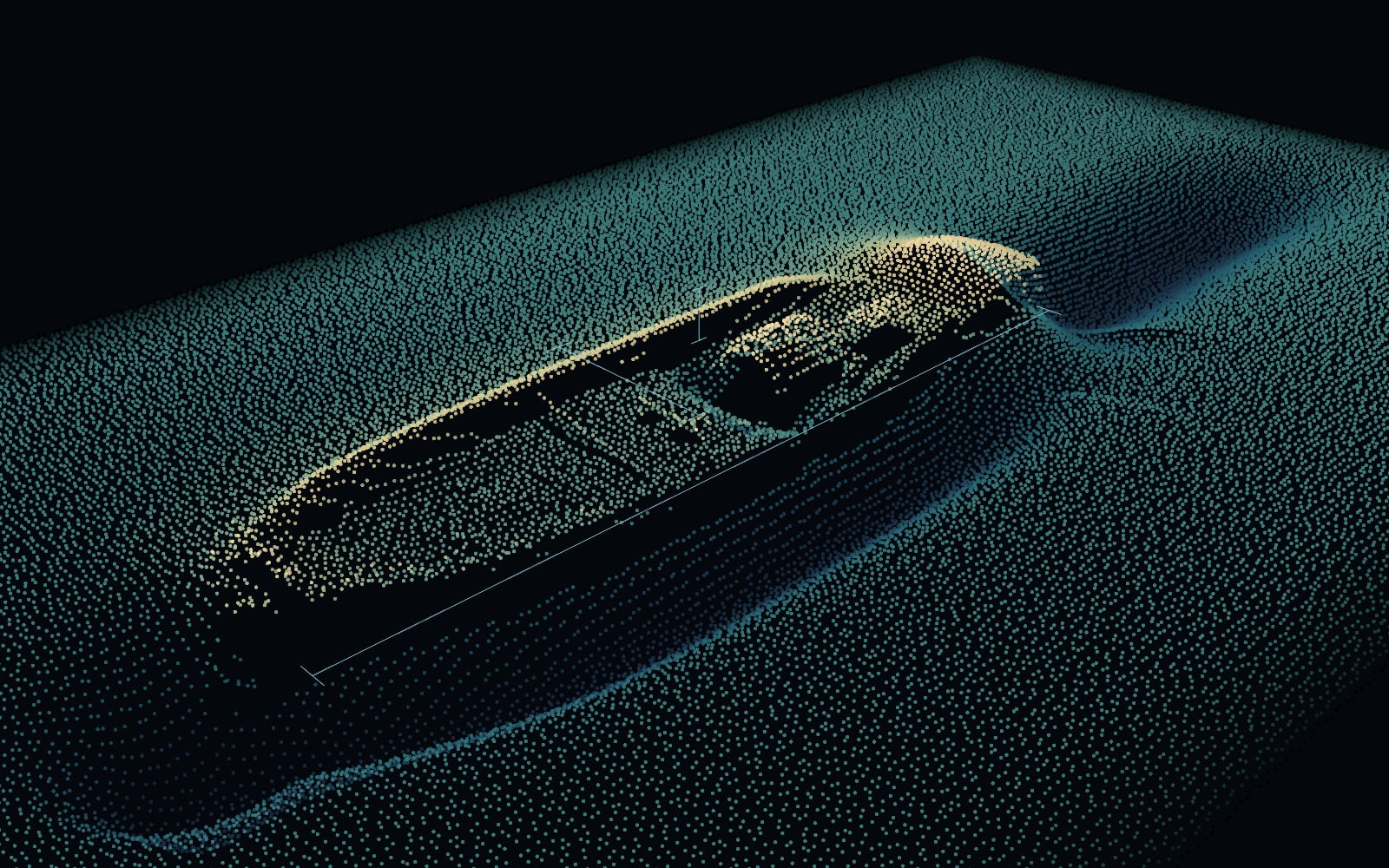
The wreck lies upright and low in the silt, inside its own scour. A published 2012 diver description (Carl Racey, Scarborough Sub Aqua Club) found her “sat upright and quite intact from bow to engine area … but aft of this she disappears into the silt”, with the port side scoured and the starboard side silted to the gunwale. The 2016 hydrographic record gives a footprint of about 29.1 × 6.6 m, a maximum height of 2.1 m and a scour 56.6 m long and 3 m deep. Divers report visibility of only a few metres, so most views clear the water for clarity and say so.
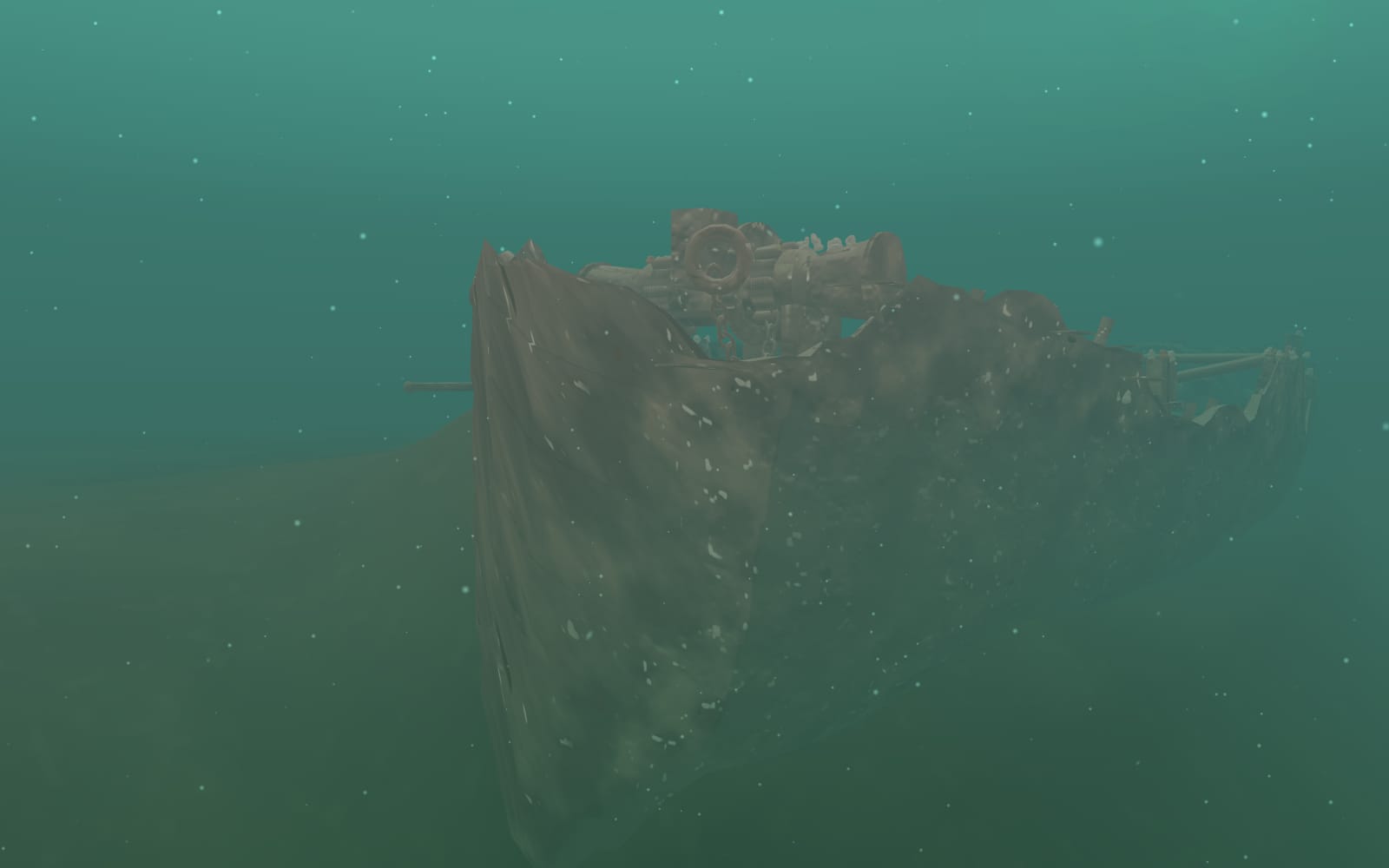
The bow
Diver account · 2012
“The port side is scoured out and it is possible to see the bottom of the stem post at the bow.” The bow is drawn upright and intact, its stem foot exposed in the scour.
The winch (published caption: anchor winch)
Genuine photograph Shape: interpretation
Danny Myers’ photograph shows a horizontal barrel with a flat end, a larger gear disc behind it and a rounded housing, under turf and soft coral. The caption calls it the anchor winch, and her survey records an iron windlass and no capstan. An alternative reading is the steam trawl winch, which stood midships.
Admiralty-pattern anchor
Photograph caption Position: interpretation
“Clearly visible is the anchor winch and the admiralty shaped anchor lying in the foreground. The anchor chain can be seen running out to the bow.” Earlier versions placed the anchor on the seabed ahead of the bow; no source supports that.
Open frames of the fish hold
Interpretation
Forward of the boiler the wooden decks have gone. Open frames, fallen beams and silt are a working approximation, not a record of what is there.
The gun (two diver accounts agree)
Diver account · published 2012 Local report · unpublished
“There is a small gun on a pedestal which has fallen over with the barrel uppermost. This is just in front of the boiler on the starboard side.” Carl Racey, 2012, quoted by David Pendleton. Local first-hand feedback, relayed by the site’s founder, also places the gun on the deck here.
The single boiler
Documented · Lloyd’s Register Position: interpretation
One single-ended boiler with two plain furnaces, by Earle’s of Hull. At 11 ft 6 in (3.5 m) across it is taller than the 2.1 m the survey allows, so it must sit partly sunk; it is drawn as the wreck’s highest point, its two furnace mouths facing forward.
Engine remains
Type documented Diver account State: interpretation
A triple-expansion engine with cylinders of 11, 20 and 32 inches. Divers describe a recognisable engine area where the intact section ends; it is drawn collapsed and part-silted.
Where the hull disappears
Measured survey · partially buried Diver account
Aft of the engine the hull sinks into the silt. About 5 m of the stern is assumed to lie under the mound. Damage there is not shown: the 2012 diver’s suggestion of a mine strike at the stern is his own inference.
The scour
Measured survey · 2016
56.6 m long and up to 3 m deep. Which end it runs from is not recorded; it is drawn running aft, and nothing here implies a compass direction.
Photograph viewpoint (approximate)
Genuine photograph
One plausible place for Danny Myers’ camera. The direction and distance were not recorded.
Soft coral
Presence: photograph Distribution: artistic
Dead man’s fingers (Alcyonium digitatum), cream and a few orange, clustered on high points as in the photograph. Where each colony sits is invented.
Sonar-style
A point cloud coloured by height, generated from this 3D interpretation so that the shape of the site can be read at a glance. It is not survey data: no multibeam data for Garmo was available. The only measurements are the 2016 hydrographic figures, drawn as dimension lines: about 29.1 m long, 6.6 m wide and up to 2.1 m high.
The gun: two accounts that agree
Both diver accounts place the gun on the deck of the wreck, just in front of the boiler on the starboard side. It is drawn there, fallen over with its barrel uppermost.
Account A Published diver account
“A small gun on a pedestal which has fallen over with the barrel uppermost … just in front of the boiler on the starboard side.” Carl Racey, Scarborough Sub Aqua Club, 2012, quoted by David Pendleton.
Account B Unpublished local report
The gun lies on the deck, in the place account A describes. First-hand local feedback relayed by the site’s founder, Nicholas Correia; not yet published or dated. (An earlier version of this page recorded it as lying on the seabed near the stern; that has been corrected.)
Recorded dimensions
- Registered length
- 34.20 m (112.2 ft)
- Registry
- Beam · depth
- 6.58 m · 3.54 m (21.6 · 11.6 ft)
- Registry
- Tonnage
- 203 gross · 71 net
- Registry
- Surveyed footprint
- about 29.1 × 6.6 m, up to 2.1 m high
- 2016 hydrographic record
- Numbers
- GY 1165 · Admiralty No. 810 · Official No. 113172
- Registry · Admiralty
The photograph
Remember them
This is the last resting place of men lost in the sinking. Please treat it with respect.
- Thomas W. Berry Able Seaman
- Thaddeus Gilbert Skipper RNR · died of wounds 21 December 1914
- John R. Hare Cook RNR
- Thomas G. Harris Able Seaman
- Walter R. Sparrow Deck Hand RNR
- Joseph W. Thornton Second Hand RNR · named James in a local account
About this rendering
- Artistic choices (not evidence): weather, sea state and sky on 20 December 1914; the sun’s bearing relative to the ship; funnel smoke; light shafts and faint caustics underwater; where each soft coral colony sits; the scour running aft; hull and upperworks colours; the Admiralty number painted on the bows.
- Water. The underwater colours are calibrated to Danny Myers’ photograph. Real visibility is a few metres; whenever a view clears the water further, a chip says so. Use the murk button to see the realistic visibility.
- Diver torch is an exploration aid. The reference photograph was taken in daylight only.
- Sonar-style view is generated from this model, not from survey data.
- No coordinates, bearings or depths are shown anywhere in the viewer or its saved images.
- Built with three.js r185 (MIT licence, below), with original procedural geometry and textures. No photogrammetry scan is claimed.
- The sea in the surface scenes is Ultra Water by Humpalumps (MIT licence, below), a real-time ocean simulation, on desktop computers that can run it; phones and the Low setting show a simpler sea. Its waves, like the weather, are artistic.
Keyboard controls
- ← → orbit · ↑ ↓ tilt · Shift + arrows pan · + − zoom · Home reset
- 1–8 tour views · [ ] previous and next label · T tour · M murk · S sonar-style · P photograph · Esc close
Sound and narration
Sound is off until you turn it on. The ambience is synthesised in your browser; nothing is recorded. Tour narration, if you switch it on, uses your device’s own text-to-speech voice, so quality varies by device. Captions are always shown.
Sources
- Deep Sea Trawlers · vessel particulars
- David Pendleton · history, Carl Racey’s wreck description and Danny Myers’ photograph
- Scarborough Maritime Heritage Centre · the minefield casualties
- Naval-History.net · the 1914 raid and losses
- Lloyd’s Register of Shipping 1912–13 · steamers
- Crew List Index Project · Mercantile Navy List entries (Official No. 113172)
- Hydrographic listing · Garmo (probably) External listing; it contains position data and is not a dive plan.
- Lloyd’s Register Foundation, Heritage & Education Centre · Garmo’s 1899–1900 hull survey report, midship section and boiler plan (Earle’s yard no. 471).
Sources checked 22 October 2026. Original 3D geometry and procedural textures: The Wreck Explorer, all rights reserved. Reference photograph © Danny Myers, excluded from any reuse.
Every new photograph can make this better
This is a working interpretation. If you have dived Garmo, a dated photograph, a sketch or a note of where the gun lies would let us correct the model instead of inventing detail. Share it through Voices from the Deep.
three.js licence (MIT)
The MIT License

Copyright © 2010-2026 three.js authors

Permission is hereby granted, free of charge, to any person obtaining a copy
of this software and associated documentation files (the "Software"), to deal
in the Software without restriction, including without limitation the rights
to use, copy, modify, merge, publish, distribute, sublicense, and/or sell
copies of the Software, and to permit persons to whom the Software is
furnished to do so, subject to the following conditions:

The above copyright notice and this permission notice shall be included in
all copies or substantial portions of the Software.

THE SOFTWARE IS PROVIDED "AS IS", WITHOUT WARRANTY OF ANY KIND, EXPRESS OR
IMPLIED, INCLUDING BUT NOT LIMITED TO THE WARRANTIES OF MERCHANTABILITY,
FITNESS FOR A PARTICULAR PURPOSE AND NONINFRINGEMENT. IN NO EVENT SHALL THE
AUTHORS OR COPYRIGHT HOLDERS BE LIABLE FOR ANY CLAIM, DAMAGES OR OTHER
LIABILITY, WHETHER IN AN ACTION OF CONTRACT, TORT OR OTHERWISE, ARISING FROM,
OUT OF OR IN CONNECTION WITH THE SOFTWARE OR THE USE OR OTHER DEALINGS IN
THE SOFTWARE.
Ultra Water licence (MIT)
MIT License

Copyright (c) 2026 Humpalumps

Permission is hereby granted, free of charge, to any person obtaining a copy
of this software and associated documentation files (the "Software"), to deal
in the Software without restriction, including without limitation the rights
to use, copy, modify, merge, publish, distribute, sublicense, and/or sell
copies of the Software, and to permit persons to whom the Software is
furnished to do so, subject to the following conditions:

The above copyright notice and this permission notice shall be included in all
copies or substantial portions of the Software.

THE SOFTWARE IS PROVIDED "AS IS", WITHOUT WARRANTY OF ANY KIND, EXPRESS OR
IMPLIED, INCLUDING BUT NOT LIMITED TO THE WARRANTIES OF MERCHANTABILITY,
FITNESS FOR A PARTICULAR PURPOSE AND NONINFRINGEMENT. IN NO EVENT SHALL THE
AUTHORS OR COPYRIGHT HOLDERS BE LIABLE FOR ANY CLAIM, DAMAGES OR OTHER
LIABILITY, WHETHER IN AN ACTION OF CONTRACT, TORT OR OTHERWISE, ARISING FROM,
OUT OF OR IN CONNECTION WITH THE SOFTWARE OR THE USE OR OTHER DEALINGS IN THE
SOFTWARE.
Its own third-party notices are kept with it, in assets/vendor/ultra-water/THIRD_PARTY_NOTICES.md.